
Recognizing CNC Cutting Limitations
CNC cutting, while remarkably versatile, is not universally optimal. Understanding when alternative manufacturing methods better serve project requirements prevents costly misapplication and ensures optimal outcomes. This guide examines CNC cutting limitations, identifying situations where other technologies or methods prove superior.
The analysis requires honest assessment of project requirements—volume, geometry, material, precision, and economics—matching capabilities to needs rather than forcing inappropriate technology adoption. Sometimes the best CNC cutting decision is choosing not to use it.
Volume and Economic Constraints
Very High Volumes: Mass production (tens of thousands to millions) typically favors dedicated tooling—injection molding, stamping, die casting—despite high initial tooling cost. Per-unit economics favor amortized tooling at volume; cycle times faster than CNC; and material efficiency optimized for specific process.
Threshold varies by part complexity and size, but generally CNC cutting uneconomic beyond 1,000-10,000 units depending on specific circumstances. Calculate total cost including setup, machine time, and material against tooling alternatives.
Very Low Volumes: Single parts or prototypes may be more economically produced through manual methods or additive manufacturing if geometry simple or material flexible. CNC setup and programming overhead disproportionate for trivial parts; hand fabrication faster for one-offs; and 3D printing competitive for complex geometries.
| Volume Range | Optimal Method | CNC Suitability | Rationale |
|---|---|---|---|
| Prototype (1-5) | Manual, 3D printing | Limited | Setup overhead excessive |
| Low (5-100) | CNC, manual | Excellent | Flexibility, no tooling |
| Medium (100-1000) | CNC, soft tooling | Good | Economical, flexible |
| High (1000-10000) | CNC, hard tooling | Marginal | Tooling economics emerge |
| Mass (10000+) | Dedicated tooling | Poor | Tooling amortization dominates |
Geometric Limitations
Internal Cavities and Undercuts: Standard 3-axis CNC cutting cannot produce features inaccessible from tool approach direction. Complex internal geometries, significant undercuts, or enclosed hollows require multi-axis machines (adding cost) or alternative methods.
Alternatives: 5-axis CNC machining; investment casting; 3D printing; or design modification eliminating problematic features.
Very Fine Features: While CNC cutting achieves precision, extremely fine features (under 0.5mm) challenge tool rigidity and machining economics. Micro-machining specialists or alternative methods may serve better.
Alternatives: Laser cutting/etching; photochemical machining; micro-milling specialists; or electroforming.
Extreme Aspect Ratios: Very deep holes, thin tall walls, or delicate protrusions difficult due to tool deflection and vibration. Specialized deep-hole drilling or alternative manufacturing may be required.
Material Constraints
Ultra-Hard Materials: Materials harder than cutting tool capability—hardened steels, ceramics, some superalloys—require specialized machining or alternative methods.
Alternatives: Grinding; EDM (Electrical Discharge Machining); laser cutting; or waterjet with abrasive.
Thermally Sensitive Materials: Some materials degrade from cutting heat despite cooling. Very soft plastics may melt; certain composites delaminate; and heat-treated materials may lose properties.
Alternatives: Waterjet cutting (cold process); laser with careful parameter control; or alternative material selection.
Material Form: CNC cutting requires solid stock or sheet material. Powder, liquid, or gas raw materials unsuitable.
Economic and Schedule Factors
Tightest Schedules: While CNC cutting fast, extremely urgent requirements may favor stock items or manual methods bypassing programming and setup.
Limited Budget: Lowest absolute cost may favor manual methods despite longer time, or design modification using standard components.
Design Uncertainty: If design likely to change significantly, CNC cutting flexibility advantage diminished by setup costs for each iteration. Rapid prototyping methods may serve exploration phase better before CNC production.
Alternative Manufacturing Methods
Additive Manufacturing (3D Printing): Superior for: complex internal geometries; topology-optimized lightweight structures; rapid design iteration; and low volume without setup. Inferior for: large volumes; specific material requirements; and precision surfaces.
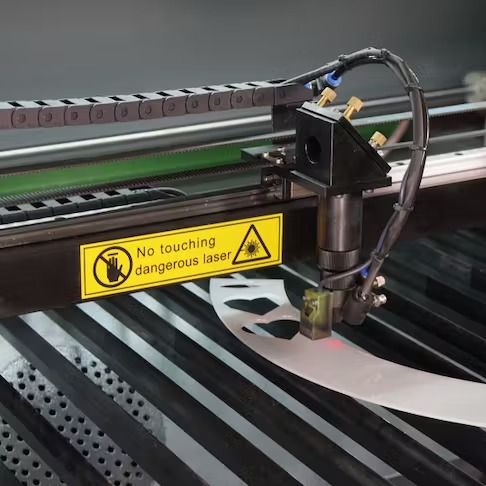
Laser Cutting: Superior for: thin materials; high detail in sheet goods; fast cutting speeds; and polished edges on acrylic. Inferior for: thick materials; 3D features; and materials unsuitable for thermal cutting.
Waterjet Cutting: Superior for: thermally sensitive materials; very thick materials; no heat-affected zone requirement; and cutting without tool wear. Inferior for: very fine detail; material cost (kerf width); and speed on soft materials.
Forming and Fabrication: Superior for: sheet metal volumes; standard structural shapes; and efficient material use in specific forms. Inferior for: complex geometry; low volumes; and precision requirements.
Casting and Molding: Superior for: high volumes; complex shapes; and net-shape production. Inferior for: low volumes; design flexibility; and initial tooling cost.
Hybrid Approaches
Often optimal solutions combine methods—CNC cutting for precision features on castings; 3D printed patterns for casting; or formed shapes with CNC-cut details. Objective matching method to requirement without ideological commitment to single technology.
Luna Graphics provides unbiased manufacturing consultation, recommending CNC cutting when appropriate and alternatives when superior. Our diverse capabilities and industry partnerships ensure optimal solutions regardless of specific technology. Contact our engineering team for manufacturing method selection guidance.
Written by Ian Love
Marketing Director
Professional contributor at Luna Graphics specializing in printing and branding solutions.